Friday, 11 March 2016

Innovation in Italy: Small farms, Big Data

I attended Fieragricola thanks to the European Network of Agricultural Journalists


“The watchword for agriculture’s future is innovation,” said Raffaele Maiorana, youth president of Confagricoltura, at Fieragricola, the 112th Agricultural Techonologies Show in Verona.

“The new course of agriculture comes inevitably from cutting-edge technologies, sustainable development, precision farming, but also the creative use of Big Data,” said Mr Maiorana.

 Big Data seminar at Fieragricola

With the average Italian farm just 7ha, sharing and accumulating data between businesses has a great potential to help individual farmers. Combining data resources gives individual farmers a level of information that would be impossible to generate alone.

The power of collecting and sharing data for innovation that could save the future of Italian agriculture was a running theme at Fieragricola.
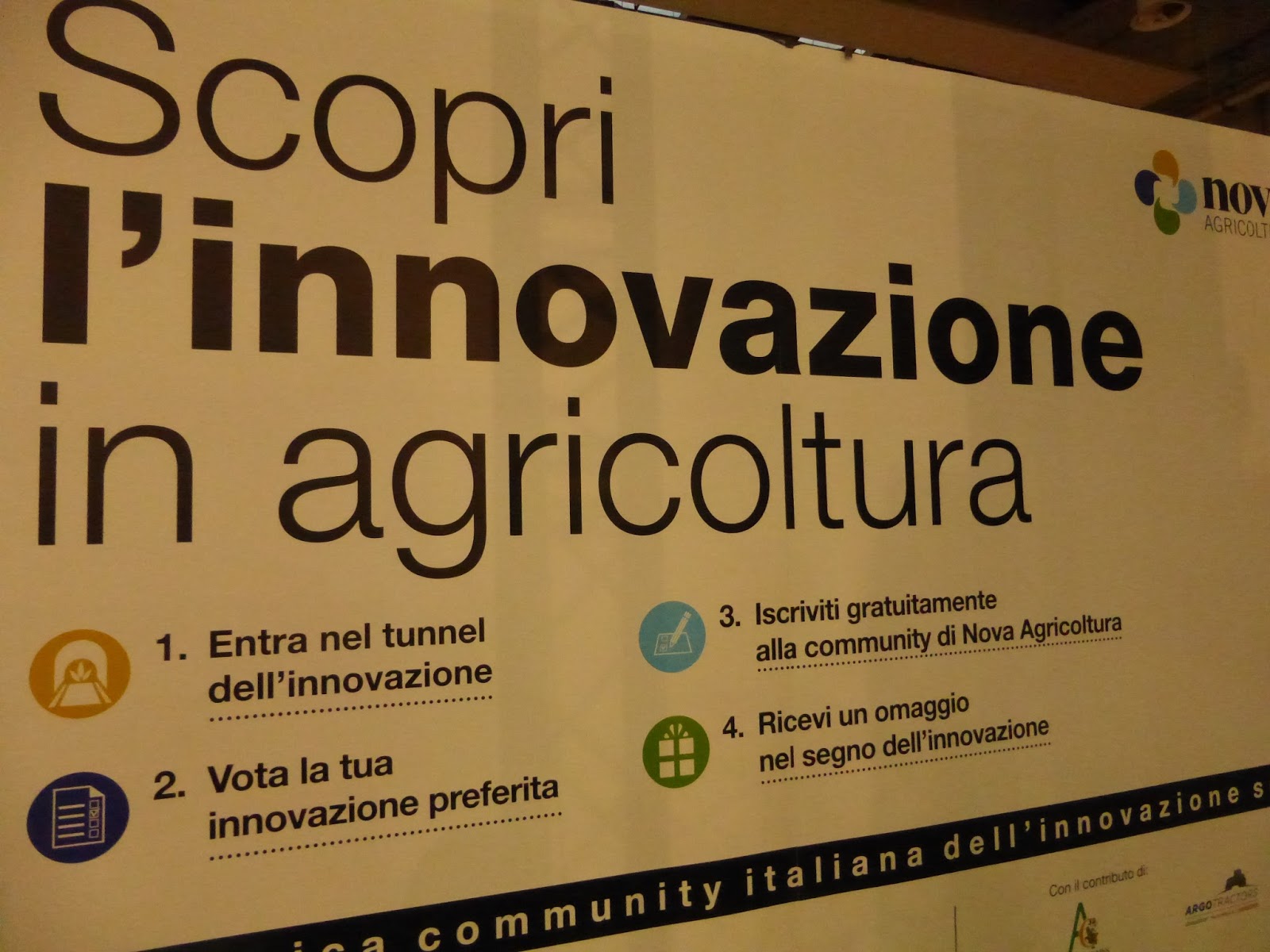
Held in Verona in the Veneto province, 3 – 6 February 2016, Fieragricola, attracting over 100,000 visitors, had a broad programme of seminars, presentations and machinery demonstrations spanning all of the Italian agricultural sectors.

For the province’s leaders, the 18,264 km² Veneto region is a fitting place to demonstrate the benefits of sharing farm data. It is home to over 665,000 agricultural companies, with growth in agricultural employment at 23%, according to Governor Luca Zaia.

Provincial President, Antonio Pastorello, said: “Agriculture is still one of the sectors driving the Veronese economy, the third Italian province in terms of exports and top in the Veneto for livestock numbers, with 57% of the regional total.”

In a seminar on the second day of the event, Mr Maiorana identified opportunities for the Italian agri-food sector to make the most of big data, acknowledging that production systems have to interact with very different information systems. The simplest case, he said, is using meteorological and environmental data compiled by external information stations to inform production cycles. For example, a system of sensors for the supply of water or the flow of rivers, could help farmers to manage their water resources.

“Agriculture is already fully involved in the digital revolution,” Mr Maiorana continued. “In the countryside it is vital that technologies integrated with the internet grow in a co-ordinated way, to ensure development and sustainable growth, attention to the land and its products. Intelligent agriculture will have to know how to use Big Data across the huge amount of available information, connecting them and interpreting them in an integrated system to help grow our industry.”

Wine growers in some regions across Italy are already contributing to and benefiting from these kinds of data networks.

Big Data in Barolo
In the Barolo area, a community of farmers upload their data to a secure website and share it with others in the group.

“Farmers get information on weather and disease modelling, which is needed for good management of the crop,” said Dr Andrea Lari of Pessl Instruments, which manages one of these data-sharing networks.

 “Farmers can also save money through collaboration, because the average farm size is not big. Tools for sharing information could help us overcome some major challenges for Italian agriculture, ecological and economical, for example,” said Dr Lari.

Data volume in Valpollicella 


Another example comes from the Consortium of Valpollicella Wines, where a project on using moth pheromone traps has grown to cover almost 2,000ha of farmland, from just 50ha in 2011. Certification is likely to be available in 2016 for those farmers in the project who correctly employ the integrated plant protection protocol, as well as for those who correctly practice the methods of using pheromones to protect against moths.

Another programme in Valpollicella, Riduci, Rispetta, Risparmia (‘Reduce, Respect, Save’), is an environmental initiative which started with ten pilot farms and now covers at least 2,000ha. Farmers involved in this scheme meet together on farms, have training meetings on farms, and receive newsletters, emails and texts – all to help farms improve their sustainability.

Monday, 18 January 2016

Nature's metaphors (or the monkey's devil fingers)

The monkey has the fingers of the devil

When I started learning a little Tajik in preparation for a volunteering trip a few years ago, my bizarre phrase book contained this gem in the section under 'animals'. I'm starting on a bit of a tangent, but it's relevant, I promise.

My question this time is - how much of our language takes its inspiration from the natural world? Where have our animals, plants, trees and skies slipped into our ordinary parlance without us noticing? We have some beautiful idioms - maybe none as strange as the monkey with the devil fingers*, but still...

In the wake of new word hoarders like Robert McFarlane, I'm setting out to make my own list (to be continued):

to weasel
to ferret
have a gander
larking around
beetling away
dog-tired
crow about s.th 
pussyfoot
to leapfrog
to be a pig
parrot-fashion
budding talent
a blossoming young woman
put down roots
.....


*I do have some doubts about this phrase, but I'll never know for sure. My phrase book was written by two people whose only common language was Esperanto, living hemispheres apart from each other.

Thursday, 8 October 2015

Happy poetry day

Leaves burning
Trees
Hot embers in the forest -
A sacrifice to the summer,
perhaps,
But quickly put out
by October's rains.
Now the glow of
iron stones in a river.

Tuesday, 1 September 2015

An excerpt on ecological conversion

From the Holy Father’s letter of 6 August 2015 to Cardinals Koch and Turkson:

As Christians we wish to contribute to resolving the ecological cris is which humanity is presently experiencing. In doing so, we must first rediscover in our own rich spiritual patrimony the deepest motivations for our concern for the care of creation. We need always to keep in mind that, for believers in Jesus Christ, the Word of God who became man for our sake, “the life of the spirit is not dissociated from the body or from nature or from worldly realities, but lived in and with them, in communion with all that surrounds us” ( Laudato Si’ , 216). The ecological crisis thus summons us to a profound spiritual conversion: Christians are called to “an ecological conversion whereby the effects of their encounter with Jesus Christ become evident in their relationship with the world around them” (ibid., 217). For “living our vocation to be protectors of God’s handiwork is essential to a life of virtue; it is not an optional or a secondary aspect of our Christian experience” (ibid.).

1st September is the day of prayer for the care of creation

Friday, 24 April 2015

Wealth

...continuing to quote from Barry Lopez's Arctic Dreams,

In the following narratives [of Arctic exploration], it is not solely the desire of some men for difrerent sorts of wealth that becomes clear, but the suspicion that North America offered more than material wealth. It offered wealth that could not be owned, like the clarity of the air and the sight of 300,000 snow geese feeding undisturbed on the Great Plain of the Koukdjuak...We seem vaguely uneasy with the notion that a flock of snow geese rising like a snowstorm over Baffin Island is as valuable or more to mankind than the silver, tin, and copper being dug out of the Bolivian Andes at Potosí. These are not modern misgivings;  they daye in North America from the time of Columbus and Cabot...
(pp.312-313)

Apologies for the long passage today. I like the idea of wealth that cannot be possessed, because it makes it a communal asset. If I don't possess A, it means that my friends can also enjoy it. But it does make me wonder about responsibility with relation to possession. If I own, say, a tree in my back garden, I have a responsibility to make sure it is safe and well looked after otherwise it will be my fault if it dies. If there's a tree on the patch of communal land outside my house, whose responsibility is it to protect that tree, to make sure it thrives and grows beautifully old?

Wealth that cannot be owned by any individual cannot be traded. It cannot be bargained for, charged interest on, entered into ledger books or spreadsheets. It makes me think of Oliver's song: "Who will buy this wonderful morning?" The rising sun is one of our most valuable assets and yet completely and utterly un-possessible. Just a thought.

Wednesday, 15 April 2015

The mind's intercourse with the landscape

In his book Arctic Dreams, the American author Barry Lopez writes:

"...language is not something man imposes on the land. It evolves in his conversation with the land - in testing the sea ice with the toe of a kamik, in the eating of a wild berry...A long-lived inquiry produces a discriminating language. The very order of the language, the ecology of its sounds and thoughts, derives from the mind's intercourse with the landscape."

As I walked to work today, I wondered about the intercourse of minds with the landscape in my own community, and the effect this may have on our language and therefore on our perception of our own environment. (Incidentally, the German word Umwelt, meaning 'environment' but which I translate literally as 'world around oneself' helps me understand better what we mean by 'environment').


If we're not letting our minds interact, study, perceive the landscape, what happens?

It makes me wonder whether it's a vicious cycle. The less time we spend outside, the less we understand; the more language we lose with which to describe our landscape and so more estranged we become from the natural world around us.

Perhaps today, then, I'd advocate spending just a little more time outside, looking, listening and letting our minds explore.


Monday, 6 April 2015

Life

I've been doing some preparation for a church youth group session and hence pondering on the meaning of 'life'. (Not the answer 42, before any Python fans jump in).

What is the word 'life' for us? Is it just our physical existence? Or is it something more?

From the Greek New Testament of the Bible, I've discovered, there are two types of 'life' - bios, the earthly, physical existence; and zoe. Zoe is altogether more exciting.

Zoe is the adventurous, vital, genuine, vigorous, generous, authentic state of being.

What if life is more than simply existing? More than eating, breathing, sleeping? More than having our physical needs attended to? More than consuming and acquiring?

In Barry Lopez's book Arctic Dreams, he often talks about the lifestyle of the people that inhabit the arctic, and there's one particularly relevant point he makes in a passage on Eskimo hunters. Lopez writes:

They [Eskimo hunters] have a quality of nuannaarpoq, of taking extravagant pleasure in being alive; and they delight in finding it in other people. (p.202)

This is existing and much more.

More reading:
http://www.biblestudytools.com/lexicons/greek/nas/zoe.html 
http://www.scripture4all.org/OnlineInterlinear/Greek_Index.htm  
http://biblehub.com/greek/979.htm 
Luke 12:13-15 & 22-23 
Barry Lopez, Arctic Dreams

Sunday, 22 March 2015

Two types of fear

Thanks to Barry Lopez' Arctic Dreams  for these...

The Tununirmiut Eskimo on Bylot Island have at least two words for fear (maybe more?):

ilira - fear that accompanies awe (like watching a polar bear)
kappia - fear in the face of unpredictable violence (having to cross thin sea ice)

Do either of these apply in the face of our changing climate? Are we sitting back and experiencing ilira, watching the changes take place from a point of relative safety, or have we got collective kappia yet? Are we as afraid as we should be?

Barry Lopez published his Arctic Dreams in 1986.

Saturday, 24 January 2015

It doesn't sound bad enough

My complete thanks go to the Now Show (BBC R4, 23 January 2015) for this post.

Global warming and climate change don't, to many people, sound that bad, said Nish Kumar. Too true. In the middle of the damp, cold, bone-biting, and joint-aching January, a bit of warmth doesn't sound like all too bad a thing. A changing climate is neither here nor there. We're surrounded by change all the time.

We need some alternatives, and here are a few of Nish's suggestions:

"Turdpocalypse"
"Kicked in the weather-balls"

And, for the CEOs of major corporations, whose major concerns at Davos were regulation and taxation:

"Increased regulation and taxation of ...oxygen"

(Listen online for the next 29 days, go on, do: http://www.bbc.co.uk/programmes/b04yk373http://www.bbc.co.uk/programmes/b04yk373)

Time to think of some more emotive, urgent synonyms for global warming and climate change. And while we're at it, green. It doesn't make sense, really. How can a colour be a solution to a weather-based issue?. What words do we use to make it sound worse? Perhaps we need to be more concrete: drought, flood, fire. Hunger, famine, war. 

Sunday, 11 January 2015

Land ethic

What's changed in the last 60 years?

In 1949, the American forester and writer, Aldo Leopold wrote in his Sand County Almanac and Sketches Here and There, that what we lack is a system of ethics.

There is as yet no ethic dealing with man's relation to land and to the animals and plants which grow upon it. Land, like Odysseus' slave girls, is still property. The land-relation is still strickly economic, entailing privileges but not obligations...

And, later on in the same work:

We have no land ethic yet, but we have at least drawn nearer to the point of admitting that birds should continue as a matter of biotic right, regardless of the presence or absence of economic advantage to us.

Sixty years on, have we got the ethics we needed? Or is our relationship to the land limited to economic terms?

Friday, 19 December 2014

December haiku

Winter coming home
Butterfly in a lampshade
Paper flickers dark

Thursday, 6 November 2014

A non-verbal homage to Cubbington Woods

I won't write the obvious cliché about the value of pictures, though you can probably guess what it is. In this blog I wanted to tell the story of a wood just to the north of where I live, which lies in the proposed trajectory of HS2. It's where we go blackberry picking in the late summer; people walk their dogs nearby, and it's close enough to the edge of town to be just the right balance of accessible but wild. Sometimes there are buzzards.

This is my homage to the Cubbington Woods:


All of the above are (c)Eleanor Perkins

Wednesday, 29 October 2014

Word of the day?

Just a quick exercise today, to see what some of our online media providers are writing about in their environment sections at the moment. Click on each of the wordles to see the original in detail.

A selection of today's hot words are:
- Continue
- Just
- UN
- Britain
- Government
- Trillion

Guardian environment:

 Wordle: Guardian Environment, 29/10/2014
Telegraph Earth

Wordle: Telegraph Earth, 29/10/2014

BBC Science/Environment:

 Wordle: BBC Science/Environment 29/10/2014

Independent Environment:

Wordle: Independent Environment 29/10/2014

Tuesday, 28 October 2014

Nature as a poet: John Muir

Nature as a poet, an enthusiastic workingman, becomes more and more visible the farther and higher we go; for the mountains are fountains - beginning places, however related to sources beyond mortal ken.

John Muir (1838 - 1914) writes effusively in My first summer in the Sierra of the wonders that he sees. Every tree, flower, mountain, and even house fly he sees there is a miracle, a beauty to be contemplated; to be enjoyed and protected. In 1869, he is the companion to a group taking a herd of sheep ('woolly locusts', he terms them) to find fresh pasture in the mountain meadows of the Yosemite. Taking his leave of the group for sometimes days on end, Muir walks and sketches and makes copious notes of his surroundings.

I think his predecessor and fellow Scotsman, Hugh Miller (1802 - 1856) would have agreed with Muir's 'nature as a poet' approach:  

Nature is a vast tablet, inscribed with signs, each of which has its own significancy, and becomes poetry in the mind when read; and geology is simply the key by which myriads of these signs, hitherto indecipherable, can be unlocked and perused, and thus a new province added to the poetical domain. (Lecture third) 
 

Thursday, 16 October 2014

Blog action day: inequality

Inequality, to me, is legalese. It's harsh, unfeeling and grey. The word doesn't demand action of us: it's a state of being, a mathematical comment on the way the world is. A brick is heavier than a feather - that's inequality. It doesn't make me want to do anything about it.

So I wondered about the synonyms for inequality, and a quick search on the clever Google Ngram showed me something interesting. We used to talk about injustice much more than we talked about inequality. Something happened between 1973 and 1974, and inequality took over. There's not space (or time) to look at why that happened, but it seems that the sense of justice went out of fashion. We were no longer talking about what was right or wrong.

Does 'injustice' demand more response than 'inequality'? Or which other words could we use?

Here's the graph, and you can have a go yourself, using a good thesaurus (or thesaurus.com) and Google Ngram.

(For comparison, I've also included 'unfairness', which doesn't seem to have been very popular at all.)

Find out more about Blog Action day

Saturday, 13 September 2014

Possession. Can you live without this verb?

"Possession is nine points of the law", goes the early seventeenth-century proverb. What would happen to our understanding of possession if we had no verb to express it?

Scottish Gaelic (and other Celtic languages) has no possessive verb.  I quote from "Gaelic made easy", by John M. Paterson (1952):

We know that when you want to say that a person has anything, you put it as being "at him". Thus THA TAIGH AIG IAIN, A house is at John, or, John.....THA FIOS AGAINN GUM BHEIL AIRGIOD GU LEOIR AGAIBH, We know that you have plenty of money; or [literally], knowledge is at us that money galore is at you.

What would happen if we took away our English verb 'to have'? In Gaelic, we're stating the facts - there's a house and it's with John. There is some money and it happens to be in your pockets. To me, this sounds less permanent, accepting the transient nature of the world by the very grammar used. It makes me think that the things we talk about owning don't really belong to us in the first place - they belong to someone else and we're borrowing them for a while.

It's easy to forget that, really, everything is a gift; everything we use, borrow, eat. How about giving up the verb 'to have' for the day?

(You might want to check out the Story of Stuff for more on this topic)

Thursday, 4 September 2014

Gypsy storytelling

Should sustainability be an abstract concept? I went to a talk by Damian le Bas last weekend at Greenbelt on Romany language, storytelling and culture and I asked him how he would express the concept of 'sustainability' in Romany.

The answer he gave all of us was surprising at first. For all the precious lessons that Romany people have learned from the past about travelling light, for their low carbon footprint, there's no word for sustainability. Granted, Romany is an evolving language, but there's no English Romany word for 'sustainability'. According to Damian, English Romany is not often used for abstract ideas; more for saying "I'm going up the hill to catch a rabbit".

However, the Professor chipped in, there is an international Romany constructed word, dur-shayipe; sort of 'long term ability to carry on, etc', which can be used in the context of sustainability. They both agreed, though that it's a word with little currency.

This got me thinking. Should something so vital to our existence be relegated to the realm of the abstract? Where's the concrete language to talk about what we mean?

Saturday, 16 August 2014

The key to survival

"...a place where knowing your environment is the key to survival." *

We rarely think about how our knowledge of our surroundings is a matter of life or death. We reserve that for people living in the more out-of-the-way places, where the weather is more severe, and the natural landscape hazardous.

But it's not quite true.

I know that if I walk across a certain road at the wrong time, my life is in danger. I know that this particular alleyway is narrow and dark and should be avoided at night. I know to be wary of certain wild animals. I know that these berries are tasty and these berries are deadly poisonous. I know how to keep food so that it won't go off. I know, more or less, the things which will help me preserve my life and those which will bring it to a more rapid end than I'd wish.

This is true for me, someone who lives on the edge of a medium town in a pleasant county.

Knowing our environment is always a key to survival, wherever it is. We need to understand that our environment isn't somewhere 'out there' where the wild things are, and see that it's here, right where we are.


* I took this from the concluding statement of BBC's Human Planet episode, Arctic life: in the deep freeze. It's currently available to watch on iPlayer: http://www.bbc.co.uk/iplayer/episode/b00rrd7r/human-planet-3-arctic-life-in-the-deep-freeze

Saturday, 5 July 2014

These are a few of my favourite...

...words. I did a quick straw-poll on Facebook this week, asking a simple question:

What's your favourite word?

I'm not sure that any of the answers are words that get used very often, but they're an interesting mix of foreign, emotive, philosophical, onomatapoeic expressions. A lot were chosen for the way they feel to say; some for the meanings and a couple for their flexibility.

I wonder whether a piece of writing containing one of these favourite expressions would make the reader more likely to take notice?

Presumably someone, somewhere has mapped the nation's favourite words.

Here's the list I got:

- Bizarre
- Shenanigan
- Autumnal
- Lassitude
- Plinth
- Gloopy
- Lentosaema (airport in Finnish)
- Unheimlichkeit
- Crepuscular
- Quail
- Rationalise
- Delectable
- Defenestration
- Shagala bagala ('mess' in kiSwahili)
- Hobb
- Abominate
- Idyllic
- Slake

I should point out that one of my friends takes umbrage with this question of ' favourite words', as it subscribes, in his opinion, to false economic reason. We ought not, he tells me, reduce the massive complexity of language to mere words. Thanks, JB.

Tuesday, 11 March 2014

...is a foreign word

Nachhaltigkeit ist ein Fremdwort, writes Silvia Schaub in her article in Schweiz am Sonntag at the weekend.* 'Sustainability is a foreign word'. In German, Sustainability is a word taken from another language. A foreign concept, rendered into German by using the existing building blocks: nachhaltig, 'sustained, lasting, persistent' and keit, a suffix like the English -ness to turn it into a noun expressing the concept of being sustained or lasting.

It's clunky but functional - not unlike our English Sustainability. It's a construction; a concept that we're learning to live by because, as Silvia writes, it's better than the alternatives.


*'Ende der Monokultur - Zeitenwende im Garten', Schweiz am Sonntag, 9.März, pp. 50 - 51.